
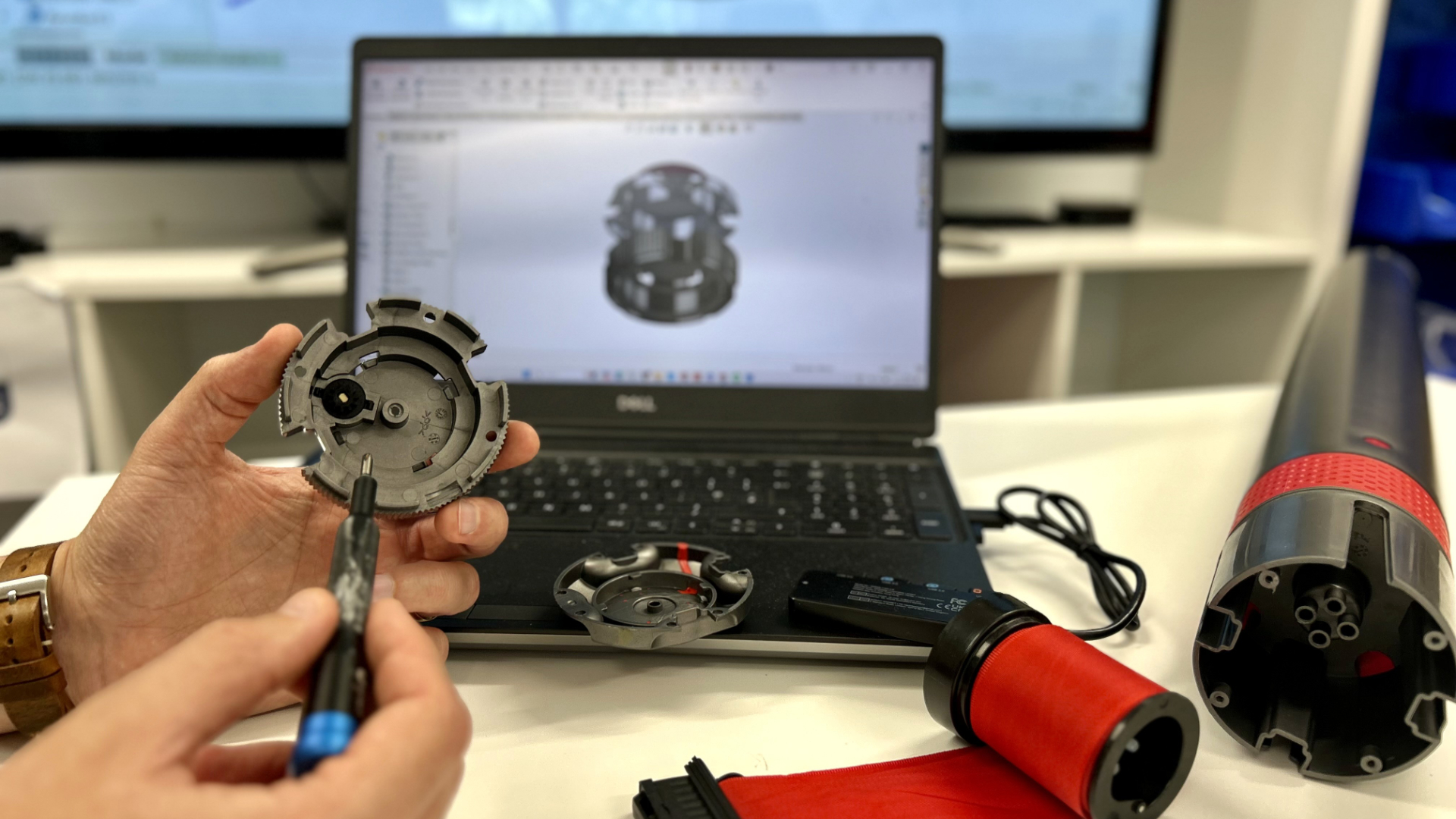
DFM stands for design for manufacture: designing a product so it can actually be built at a cost and volume that make commercial sense, not just something that works on screen. The decisions that determine whether a product is cheap or expensive to produce get made early, often before a single prototype exists, and get harder to change the further a project moves toward tooling.
This guide covers what DFM actually means and how it differs from the terms you'll often see alongside it – DFA and DFMA. The real differentiator, though, is what changes when a product has several parts working together rather than just one, which is where most existing DFM guidance falls short.
4D Products designs and engineers products as one in-house team, from early concept through to manufacture, which means DFM isn't a separate review handed to someone else partway through a project, it's built into the design from day one. If you'd rather discuss your own product directly, get in touch with our team.
In practice, that means the decisions about material, process, and assembly method all get settled early, while they're still cheap to change, rather than discovered once tooling has already started. A part redesigned on screen costs a design revision. The same part redesigned after tooling has been cut costs the tooling modification itself, the delay, and whatever redesign follows.
The Institution of Mechanical Engineers, the UK's principal chartered body for the profession, has represented mechanical engineers since 1847. Mechanical engineering as a discipline has always spanned design through to manufacture, not design in isolation, and that's the right way to think about manufacturability generally: not a separate specialism bolted on afterwards, but part of doing mechanical design properly.
You'll see design for manufacture, design for manufacturing, and design for manufacturability used interchangeably (more on that in the FAQs below), and nothing meaningful separates them. Where the real confusion starts is with the other acronyms that tend to appear alongside DFM.
Once DFM gets mentioned, two more acronyms usually follow it: DFA and DFMA. They're related, but distinct, and the difference is worth knowing before working with anyone who uses them.
DFM (Design for Manufacture)
DFA (Design for Assembly)
DFMA (Design for Manufacture and Assembly)
The combined discipline, DFMA, was formalised by the British-born engineer Geoffrey Boothroyd and his collaborator Peter Dewhurst, who received the US National Medal of Technology and Innovation in 1991 for developing it. In practice, most product development work touches both DFM and DFA at the same time, not as two separate reviews run at different points in a project. Treating them as one continuous decision is usually more useful than keeping the acronyms strictly apart, since the two disciplines are answering related questions about the same design, and a change made for one nearly always has a knock-on effect for the other.
Most DFM guidance online is written for a single part: a bracket, a machined component, something going to one supplier for one process. That's a reasonable starting point when there's only one component in the mix, but it stops being useful the moment a product has more than one part, which describes most products a business is actually developing. A real product is rarely as simple as a single component. It's usually a mechanical enclosure, a PCB assembly, several materials, and more than one manufacturing process, all of which affect each other rather than each passing its own review in isolation.
The three examples below span industrial, consumer, and medical products, different sectors with different constraints, but the same manufacturability problem underneath.
ARM Gateway is a good example of what that actually looks like. The device had to stack in towers of up to five units, with thermal performance holding up whether a unit was stacked or used on its own, a manufacturability problem that isn't really about any single component. Getting airflow and heat dissipation right across a stacked configuration meant working through mechanical engineering and 3D CAD together, not resolving one part's manufacturability and hoping the assembly behaved.
MiaCam, a web-connected camera, needed an enclosure housing a Raspberry Pi, a camera module, IR LEDs, a power circuit, and a light sensor, while still allowing tilt adjustment for different installations. One of the harder manufacturability problems was creating a uniform light pipe from a cluster of individual LEDs, solved through prototyping and testing fit and function as the internal layout evolved. That's the kind of interaction between electronics and enclosure design a single-part DFM checklist doesn't account for.
Micrima shows DFM driven by something other than cost. Their breast tissue-scanning device needed a Faraday-shielded enclosure built to the EN 60601 medical electrical safety standard, with the shielding, the electronics, and the standard itself worked out together from the first sketch. Compliant working prototypes were ready within 12 weeks of briefing, a timeline that wouldn't have survived treating manufacturability and regulatory compliance as two separate reviews.
What made each of these outcomes possible wasn't optimising one part in isolation. It was treating manufacturability as a property of the whole product, checked as one thing rather than ticked off component by component.
Get in touch if you'd like to talk through how this applies to your own product.
A handful of decisions do most of the work in a DFM review, and on a full product, none of them can really be settled in isolation:
None of this happens as a checklist run once at the end. Design for manufacture work like this is most useful woven through a project from the first CAD model onward, because the six points above rarely stay independent of each other. Loosening a tolerance can change which material makes sense; reducing part count can change how a component needs to be assembled; a compliance requirement can rule out a material choice that otherwise made sense.
A design and engineering team working as one group, rather than handing a finished design to a manufacturer to critique after the fact, tends to catch those interactions earlier. Ultimately, the final DFM with the chosen manufacturer will iron out any minor modifications but factoring the above considerations into the design from the outset aims to make the end stages much more efficient.
You can read more about how that team is structured on our about us page.
The value shows up in numbers, not just principle. According to our own medical device project data, early DFM decisions have contributed to production cost reductions of up to 30% on past projects, a more specific and traceable figure than the vague "design determines most of your costs" claims that circulate without much backing behind them.
A few signals tend to show a DFM review is overdue:
None of these signals mean a project has gone wrong. They usually just mean manufacturability hasn't had a proper look yet, which is a normal point to bring someone in rather than a sign of a failed project. Talk to our team about where a DFM review would have the most impact on your product.
If any of that sounds like where your own product is right now, the fix isn't complicated: build manufacturability in from the start, rather than discovering it's missing partway through a project.
4D's design and engineering team treats DFM as part of the design process itself, not a separate check run by someone else after a design is finished. Those decisions get resolved together, by the same people, rather than discovered late by a manufacturer working from a finished drawing with no visibility into why any of it was decided. It's the same approach behind ARM Gateway, MiaCam, and Micrima above, and it's why clients come to us when a product has to work as a whole, not just pass a single-part review.
If you're not sure whether your own product has had a proper DFM review, or you're bringing a new one to market, get in touch with our team to talk it through.
Our expertise covers:
DFM (design for manufacture) focuses on the part itself: material, process, and how cheaply and reliably it can be made. DFA (design for assembly) focuses on how parts go together: fewer components, simpler fasteners, and less room for assembly error. See the comparison above for more detail.
Yes, along with "design for manufacturing." All three terms get used for the same practice, and nothing in how they're applied actually distinguishes one from another. If a supplier or an agency uses a different one of the three than you're used to, it isn't worth reading anything into which term they picked.
Both. Electronics have their own manufacturability considerations, component selection, PCB layout, and how a circuit board interacts with its enclosure, that matter just as much as tolerances on a machined part. A product combining mechanical and electronic components needs both reviewed together, not separately.
In practice, both, but the earlier a manufacturer's constraints are factored in, the cheaper the outcome. Waiting until a design reaches a manufacturer to find out what won't work is the expensive version of DFM. Involving manufacturing input while a design is still on screen is the useful version.
A single part usually goes to one process and one supplier, so its DFM review is fairly contained. A whole product combines several parts, materials, and processes that all affect each other, so a decision that helps one component can create a problem for another. Reviewing the whole product together, rather than part by part in isolation, is what catches those conflicts.
They overlap but aren't the same. DFM is specifically about manufacturability: whether a design can be built efficiently at the cost and volume needed. Value engineering is broader. It looks at a product's overall cost against its function, and manufacturability is only one of the factors it weighs, alongside things like material substitution and feature trade-offs.