Industrial design is the discipline that decides how a product looks, feels, and works before it reaches a production line. It covers form, function, ergonomics, and manufacturability, the decisions behind whether a product is comfortable to use and realistic to build at a cost that makes commercial sense. If you're developing a physical product, it's one of the disciplines you'll need to get right alongside engineering and commercial strategy.
This guide sets out what industrial design actually means and how it differs from the other design and engineering services you'll likely see listed on agency websites. The examples further down are real 4D projects, with the figures behind them, because the difference between industrial design done well and done badly shows up in results a business can measure: fewer redesigns, and a shorter path to market.
If you'd rather discuss your own product straight away, reach out to our team.
Industrial design sits within the wider process of developing a product, rather than describing that whole process itself. It's the part concerned with how a product is actually experienced by the person using it, its shape and proportions, and whether its form genuinely supports how it's meant to be used. An enclosure that traps heat, or a control layout that's technically functional but confusing to operate, are industrial design failures even when the engineering underneath them is sound.
Increasingly, that scope includes what a product is made from and what happens to it at the end of its life, not just its shape and use. Sustainable product design sits inside the same discipline, rather than being treated as a separate add-on bolted on afterwards.
The UK's own professional body for designers, the Chartered Society of Designers, traces its roots back to the Society of Industrial Artists, founded in 1930, and still recognises industrial product design as one of its chartered specialisms today. Where this gets more useful for a business trying to work out whether it needs this expertise is in how it sits alongside the other services usually offered next to it, which is where the confusion tends to start.
The word "industrial" causes its own confusion here, so it's worth separating out early. This article is about industrial design as a discipline: the practice of shaping a product's form and how it's actually used. Our industrial product design page covers a narrower, different focus: designing products specifically for the industrial and manufacturing sector itself, things like monitoring equipment and factory machinery, rather than the discipline in general.
Within the discipline, industrial design and product design overlap enough that the terms get used interchangeably, and in practice, that rarely causes a problem. Where a distinction is useful, it's a matter of focus rather than a hard boundary. Product design usually describes the complete journey from an early idea to a manufacturable, sellable product, spanning research, concept, engineering, and production support. Industrial design usually refers to a narrower part of that journey: getting the form and ergonomics right for the person who'll actually be using the product.
Mechanical engineering design sits alongside both and answers a different question again: whether the product's physical structure actually works. That covers material selection, load-bearing capability, tolerances, and how components fit and move together, verified through prototyping rather than concept sketches.
Industrial design
Product design
Mechanical engineering design
In practice, treating these as three separate disciplines handled by three separate teams is where a lot of avoidable friction comes from on product development projects. At 4D, the same small team designs and engineers a product, so decisions about how it looks and how it's built happen in the same conversation, rather than being handed off between departments once the "creative" work is finished. You can read more about how that team is set up on our about us page.
In a live project, industrial design work moves through a fairly consistent sequence, even though the details change with every product.
It starts with understanding the user and the problem the product actually needs to solve, not just the feature list a client arrives with. This is the user-centred part of the work, and it shapes everything that follows. From there, a designer explores a range of concept directions through sketches, working out roughly what the product could be before committing time to developing any single one in detail. Our guide to the importance of conceptual design goes into this stage in more depth.
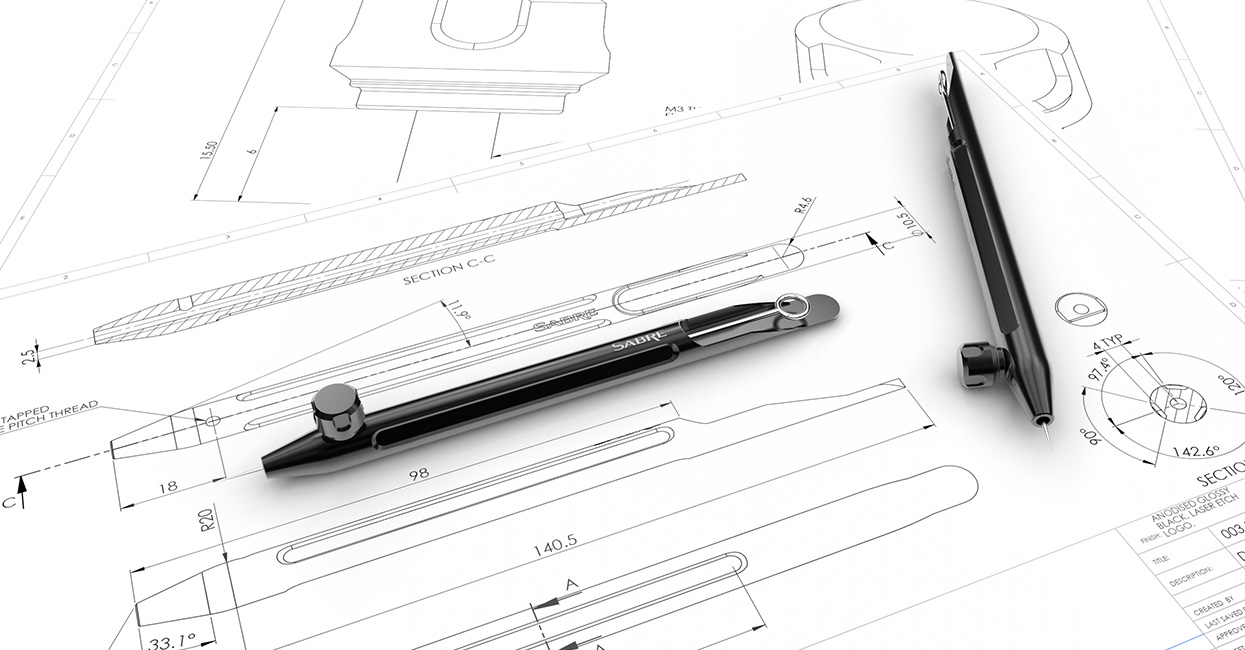
Once a direction is chosen, it moves into 3D CAD: detailed digital models that define exact dimensions, surfaces, and how parts fit together. This is also where manufacturability gets tested properly. A shape that looks right on screen can be difficult or expensive to produce, so decisions about materials, tooling, and assembly get folded in at this stage rather than discovered later, which is the core of good design for manufacture.
From there, the design moves into prototyping: physical versions built to test fit, function, and real-world use before committing to production. Our guide to the wider product design process covers what happens beyond this point in more detail.
None of this works well as a solo exercise, handed off between separate teams at each stage. The value of doing it properly shows up later, in whether the finished product is cheap to make, comfortable to use, and free of the redesigns that come from problems surfacing too late. If you'd like to see how this looks against a real product, our team is happy to walk through it.
The value of industrial design isn't abstract: it shows up in specific numbers on specific projects.
Football Flick, an urban football skills trainer, had to hit three targets that don't naturally sit together: reliable in daily use, affordable enough to manufacture at volume, and genuinely fun to play with. Getting that balance right at the concept stage, rather than discovering the conflict once engineering was already underway, is the reason the product succeeded commercially rather than just looking clever on paper. Sales passed 1,000 units, professional football clubs took it on, and the company's own figures show the first year of sales covered the full cost of development.
Rezzil, a foot-mounted VR training accessory for elite athletes, had a six-week brief to go from initial sketches to a settled design direction, a timeline with almost no room to recover from a wrong turn. Reaching that settled direction inside the window meant CAD and prototyping could begin immediately, rather than waiting on a reworked concept. The result held up well enough to secure a global patent and take Best in Show honours at Meta's Creator Week in 2022.
Micrima needed something more specific than a good-looking enclosure. Their breast tissue-scanning device required a housing that met the EN 60601 medical electrical safety standard, with Faraday shielding built into the design from the first sketch rather than fitted around a finished circuit board. Working the standard, the shielding, and the electronics out together from day one, rather than solving each in sequence, is what let a compliant working prototype reach clinical trials just 12 weeks after the brief was set.
None of these outcomes came from aesthetic decisions alone. They came from industrial design being worked through properly, and early, alongside engineering and manufacturing constraints, rather than treated as a finishing pass once the "real" decisions were already made. Get in touch to discuss what this could mean for your own product.
Industrial design isn't specific to one type of product, but the priorities shift depending on the sector.
Whatever the sector, the underlying discipline is the same: understanding the user, resolving the form, and checking it against what's realistic to manufacture.
A few signals tend to show up when it's time to bring in dedicated industrial design expertise, rather than relying on engineering alone or an in-house team stretched across multiple disciplines:
AI tools are useful for quick visualisation and exploring early ideas, but they don't resolve the things that actually carry commercial risk: whether a concept can be engineered, manufactured at a target cost, and stood up in front of real users. That judgement is built through experience with real manufacturing constraints, not generated on demand.
A structured process, run by people who've taken products through to manufacture rather than just to a rendering, reduces the risk of redesign later. If any of the above sounds familiar, it's worth talking it through with our team before committing further development budget in the wrong direction.
Our expertise covers:
Not exactly, though the terms are often used interchangeably and the overlap is real. Product design usually describes the whole journey from an early idea to a manufacturable product. Industrial design usually refers to the part of that journey concerned with how the product looks, feels, and is used. See the comparison above for more detail.
It depends on what your in-house team already covers, and on how far you trust a generated concept to survive contact with a manufacturer's quote. AI tools are genuinely helpful for exploring visual directions quickly. But knowing whether something can actually be built at your target cost, and whether it holds up with real users, is a judgement call that comes from having taken products through to production before, not from a prompt. Most businesses use dedicated industrial design expertise to sit alongside an in-house team, not replace it.
It depends heavily on the complexity of the product and how much of the wider development process it needs to cover. As a reference point, a concept stage alone typically runs two to six weeks, with the full path through detailed design, prototyping, and manufacture support taking considerably longer. The clearest way to get an accurate figure is to talk through your specific product, since generic pricing rarely reflects what a real project actually needs.
Look for a track record of real projects taken through to manufacture, not just concept renders. Ask how design and engineering work together in practice, since a design that looks right but can't be built affordably isn't much use. Named reference projects and outcomes are a reasonable way to judge whether a consultancy's claims hold up. Our about us page and case studies are a reasonable place to start if you want to see how we hold up against that test.
Yes, and it often does. Many businesses bring in outside industrial design expertise for specific capacity or specialist input, rather than handing over an entire project. It works best when it's treated as a genuine partnership: your team's product and market knowledge, combined with dedicated design and engineering input where it's needed.
As early as possible, ideally at the concept stage, before significant engineering or tooling investment has been committed. Decisions made early about form, materials, and manufacturability are far cheaper to change than the same decisions revisited after a design has already gone into detailed engineering.